

Independent Report
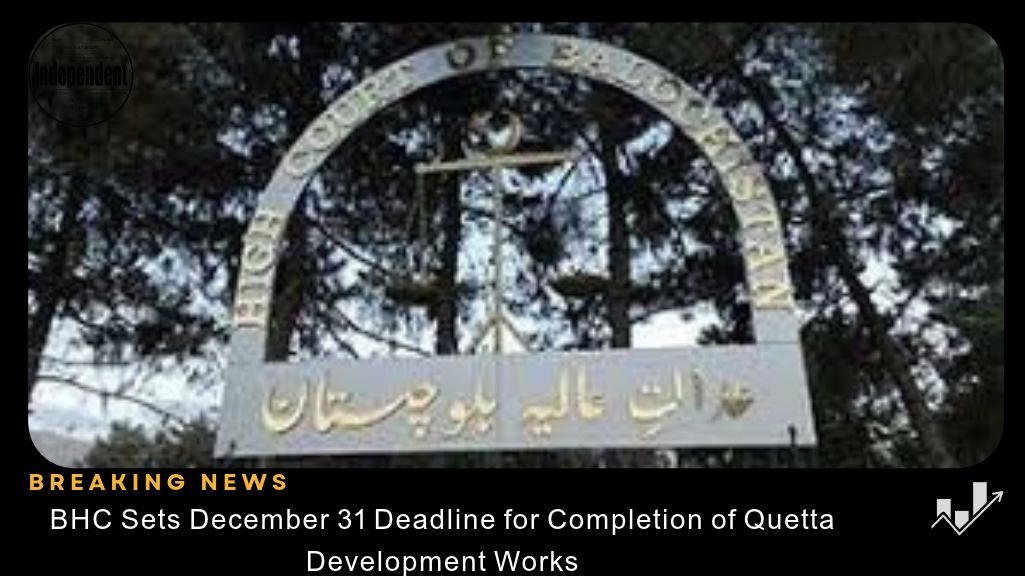
Quetta, November 29: The Balochistan High Court has ordered authorities to complete all outstanding development, sanitation and debris-removal work on Zarghoon Road, Sammungli Road and other parts of Quetta by December 31, 2026, while directing strict action against illegal dumping and the establishment of a permanent waste-management and monitoring mechanism.
A two-member bench comprising Chief Justice Muhammad Kamran Khan Malakhail and Justice Muhammad Najmuddin Mengal issued the directives while hearing Constitutional Petition No. 824/2016.
The bench examined a progress report covering road construction and related infrastructure work from Science College to Hockey Chowk and onward to Akram Hospital.
During the proceedings, the court was informed that the final asphalt layer, curb stones and paving work had been completed, while some minor modifications and improvements remained outstanding. Installation of signboards was in progress, whereas gantry boards and streetlights were still awaiting installation.
Officials also informed the court that plantation work, including the placement of climbing plants along the railway side, was underway. Debris had been cleared from Zarghoon Road, while protective railings were expected to be installed within three to four days, after which plantation activities would proceed.
The court was told that the Zarghoon Road project had failed to meet its October 31, 2026 completion deadline. Penalty proceedings against the contractor were in progress, and the applicable amount would be recovered through deduction from the contractor’s final bill.
The Metropolitan Corporation Quetta submitted a compliance report supported by photographs documenting the removal of garbage and construction debris from Sammungli Road and Zarghoon Road.
The court was further informed that arrangements were being made for the regular collection and proper disposal of municipal and solid waste at designated locations in Shahbaz Town on Sammungli Road and opposite Akram Hospital on Zarghoon Road.
Officials planned to establish waste collection points at both sites. Temporary walls or fencing would also be erected to prevent unauthorized dumping until a permanent waste-disposal arrangement was put in place.
The bench directed the DIG Quetta to deploy security personnel at the two locations and ensure regular patrolling and effective surveillance.
It ordered legal action against individuals, contractors, shopkeepers and private trolley operators found dumping construction debris or solid waste illegally at the designated sites.
The special magistrate of the Metropolitan Corporation Quetta, Anti-Encroachment Cell and relevant police authorities were instructed to ensure strict implementation of the court’s directives.
The court also directed the deputy project director to arrange excavation and preparation of flower beds along both sides of the bridge’s protective walls and complete all remaining components of the Zarghoon Road project, including roadside plantation, by December 31.
A comprehensive compliance report confirming completion of the outstanding works is to be submitted to the registrar of the Balochistan High Court in chambers through the Advocate General Balochistan’s office on December 31.
The bench directed that a copy of the order be forwarded to the Advocate General’s office for information and necessary implementation.
Further proceedings on the constitutional petition were adjourned to a date to be announced by the court office.
